
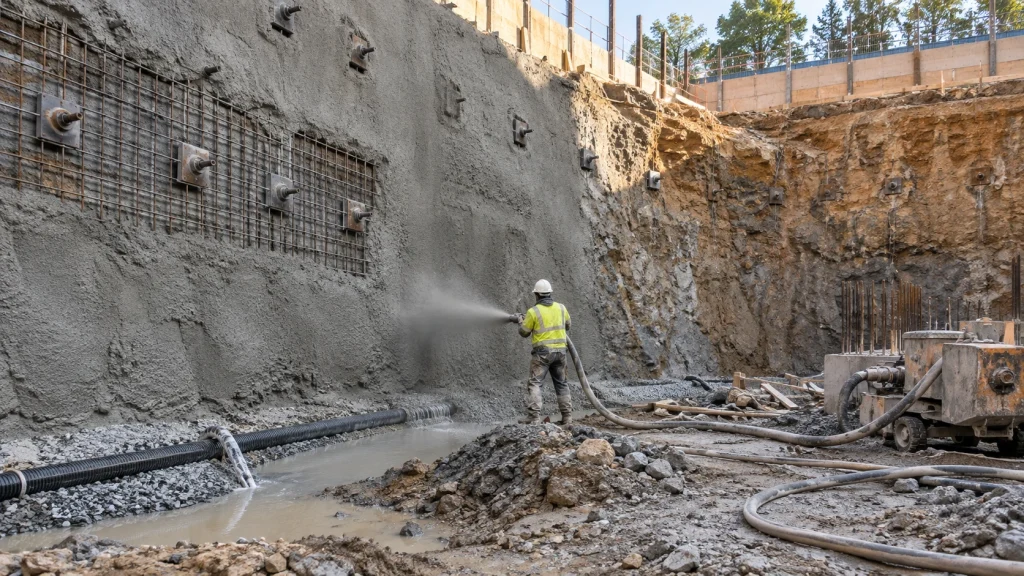
Shotcrete can help support an excavation where conventional formwork would be awkward or slow to install. Sprayed directly onto a prepared surface, it can form a layer that follows irregular soil or rock. But a neat-looking finish says little about the condition behind it. Common mistakes when using shotcrete for excavation support usually begin with planning, preparation, or the order of work, not simply with the spraying itself.
Treating shotcrete as the whole support system
Shotcrete is one part of an excavation support design. Its role depends on the ground, excavation geometry, water conditions, and any reinforcement or anchors included in the design. Assuming that a sprayed layer alone will restrain every exposed face can leave the excavation vulnerable as work continues.
Consider a basement excavation close to an existing building. The exposed face may look firm immediately after digging, but the loads and ground conditions still need to be assessed before deciding how to support it. The useful question is not just how thick the shotcrete should be. It is how the proposed support system will behave through each stage of excavation.
Excavating too far before applying support
The sequence of digging and spraying matters. Leaving a face exposed longer than planned can allow loose material to fall, weather, or soften. Cutting deeper than the support plan allows may also change the conditions that the first layer of shotcrete was intended to control.
A practical plan sets out the excavation stages, when each section will be supported, and what must happen before digging continues. Crews should understand those limits before work starts. If the exposed ground differs from what was expected, the sequence needs to be reviewed rather than carried on out of habit.
Spraying onto an unsuitable surface
Shotcrete needs a sound surface to make effective contact. Loose soil, fractured rock, dust, mud, and debris can prevent a consistent bond or become trapped behind the sprayed layer. A finished surface may then conceal weak areas instead of supporting the excavation face as intended.
Preparation should match the material being exposed. That may mean removing loose pieces, cleaning the face, or dealing with water before spraying. Overcut pockets and irregular surfaces also deserve attention: they can be difficult to fill evenly if the nozzle operator cannot direct material into them properly.
For example, imagine a rock face with a shallow recess full of loose fragments. Spraying across its opening may leave a cavity behind the visible layer. Clearing the recess and applying material so it reaches the back of the pocket addresses the problem at its source.
Ignoring water until it appears through the shotcrete
Seepage is more than a cosmetic issue. Water moving across the face can interfere with application, while pressure behind the lining may affect how the completed support performs. Covering a wet patch without understanding where the water comes from can simply shift the problem to another location.
Water management should be considered alongside the support design, especially where drainage, groundwater, or weather may change conditions during excavation. The right response depends on the site. It could involve controlling surface runoff, managing seepage, or revisiting the planned support details. Stains or damp spots after spraying warrant investigation rather than another coat by default.
Misplacing reinforcement or overlooking hidden areas
Where a design calls for mesh, bars, anchors, or other components, their position matters. Reinforcement placed too close to the ground or the finished surface may not be properly surrounded by shotcrete. Congested areas and spaces behind mesh are particularly easy to miss when access or visibility is poor.
Installation checks should happen before these components are covered. During spraying, the operator needs a clear view of the face and enough room to direct material around reinforcement. If material bridges across mesh while leaving a void behind it, a smooth outer face will give a misleading impression of the work beneath.
Losing control of application and rebound
Sprayed concrete does not all stay where it first lands. Some material rebounds from the face, especially around obstructions and sharp changes in surface shape. If rebound collects at the base or in pockets and is then covered, it can create weak zones within the lining.
The nozzle angle, spraying distance, access, and order of application all influence coverage. These details require attention as the shape of the excavation changes; a technique that works on an open, flat section may be unsuitable in a corner or behind reinforcement. Rebound should be kept out of the work rather than treated as fresh material.
Assuming one pass proves the required thickness
An uneven excavation face makes thickness hard to judge by appearance. High points may receive less cover than recesses, and changes in nozzle position can produce an inconsistent layer. A surface that looks complete may therefore differ from the design in the places that matter most.
The specified thickness, layer sequence, and any inspection points should be clear before spraying begins. Checks should be made using the method agreed for the project, with particular attention to corners, protrusions, and areas around reinforcement. Adding material later can address a shortfall, but it should follow an assessment of the existing layer and its condition.
For more detailed information on this topic, read our guide on Planning Underwater Wire Sawing for Marine Structures.
Skipping checks as the excavation progresses
Conditions can change between the first cut and the final depth. New seepage, unexpected ground, cracking, or movement may call for a review of the support approach. Continuing to spray according to the original plan without checking those changes can hide warning signs behind fresh concrete.
Good excavation support depends on a cycle of exposing the face, checking what is there, preparing it, installing the planned components, applying shotcrete, and inspecting the result. Each step gives the next one a sound basis. When something differs from the plan, pausing to assess it is more useful than relying on the finished surface to make the problem disappear.