
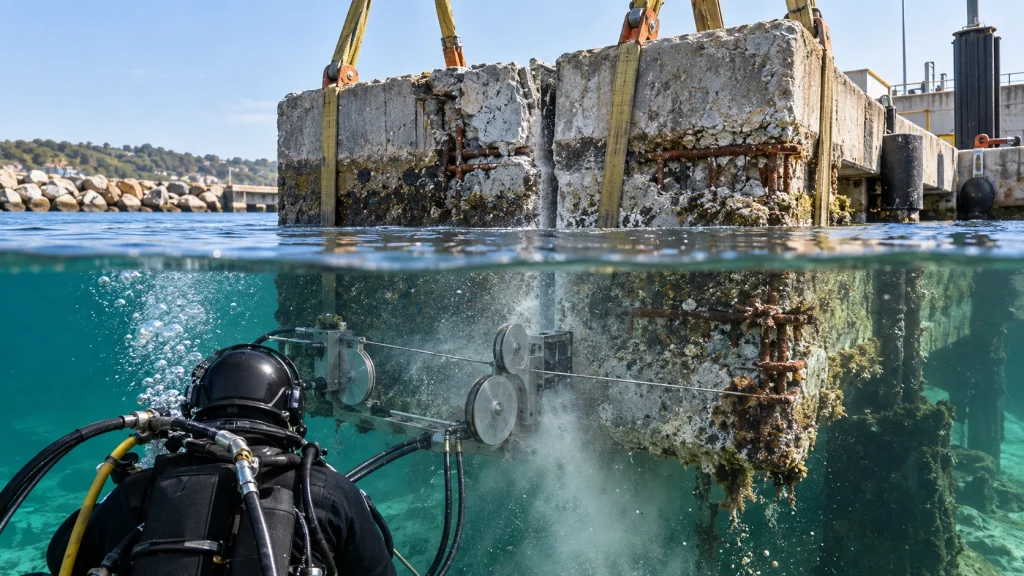
Planning underwater wire sawing starts with a question: what can safely happen to the structure once the cut is complete? A diamond wire can divide thick concrete or steel in a confined marine setting, but a clean cut is only one part of the job. The condition of the remaining structure, the weight of the section being removed, access for equipment, and the route for lifting it all need attention before cutting begins.
Define the purpose of the cut
Underwater wire sawing is used to remove damaged quay sections, cut piles, divide foundations, and dismantle submerged steel structures. The method draws a continuous diamond wire through the material using a driven pulley system. Its controlled cutting action produces little vibration compared with impact demolition, which can matter when sound parts of a quay or nearby installations must remain in place.
Start by identifying exactly what must be removed and what must stay. A drawing may show the original structure, while an inspection reveals later repairs, corrosion, missing concrete, or unexpected attachments. Those differences can change the cut line. Marking a section as “to be removed” is not enough: the plan should show its boundaries, connections to adjacent elements, and how it will be supported after separation.
Consider a quay where one deteriorated concrete panel must be replaced while neighboring panels remain in use. Cutting close to the visible damage might leave weak concrete behind; cutting farther away could affect a sound connection. Inspection and a review of the structural arrangement help place the cut where the remaining quay and the removable section can both be managed.
Inspect the site before choosing a method
An underwater survey gives the cutting team a clearer picture of the work area. Diver inspection or remotely operated vehicle (ROV) footage can help document the geometry, seabed, obstructions, and exposed surfaces. Available drawings and repair records should be checked against what is found underwater. Where hidden reinforcement, embedded items, or prestressing may affect the work, further investigation may be needed before a cut is approved.
The survey should answer practical questions:
- Can the wire be passed around the section, or will access holes be needed to thread it?
- Where can guide pulleys and the drive unit be fixed without relying on weakened material?
- Are cables, pipes, anodes, moorings, or other fittings near the proposed cut?
- Is there enough room to recover the separated piece without striking the structure?
A blade saw may suit an accessible, shallower cut; core drilling makes a circular opening and can also create passages for the wire. The material, thickness, geometry, and available working space should determine the method.
Plan the cut and the lift together
A submerged component does not become easier to handle merely because it has been divided. Before sawing, assess the size and likely weight of each piece, the lifting arrangement, and the available route from its installed position to the surface. The sequence should prevent a partially cut section from moving unexpectedly or pinching the wire.
For example, a steel frame on the seabed may be too large to recover in one lift. Dividing it into smaller sections can make removal possible, but each new cut changes how the rest of the frame is supported. The useful question is not simply how many cuts are needed; it is which section can be secured and removed after each cut without trapping access to the next one.
Cut lines, temporary support, rigging, and lifting capacity need to agree with one another. If the cutting contractor and lifting team work from different assumptions about section sizes or pickup points, the problem may only become obvious after a piece is free. A shared sequence, with hold points for inspection when conditions are uncertain, makes adjustments easier to manage.
Match equipment to the material and access
The wire and operating settings must suit what is being cut. Reinforced concrete, plain steel, and mixed sections behave differently; a heavily reinforced element may call for a different diamond wire and a more controlled cutting speed than a straightforward concrete cut. The team also needs a workable pulley path that keeps the wire aligned through the intended plane.
Confined spaces under a quay can make mounting and monitoring as demanding as the sawing itself. A diver-operated arrangement may suit a location where hands-on positioning is needed. ROV-assisted work may be considered when depth, visibility, or other site conditions make diver access less suitable.
Currents, poor visibility, vessel movements, and limited surface access can interrupt a cut or complicate inspection. Build these constraints into the work sequence, including how the team will confirm progress and check that the final portion of a cut can be completed safely.
For more detailed information on this topic, read our guide on How Controlled Rock Splitting Supports Safe Excavation Near Existing Structures.
Account for the surrounding marine environment
Controlled sawing can avoid the shock and vibration associated with more forceful removal methods, but the operation still affects the site. Concrete fragments, loosened coatings, and handling of cut sections may require containment or collection suited to the location. A plan should also address nearby services, seabed conditions, and other activities in the water or at the quay.
The last inspection matters as much as the first. After removal, verify the condition of the retained structure, document the cut surfaces and any unexpected damage, and confirm that no loose material or temporary rigging has been left behind. If the work forms part of quay rehabilitation, these findings can guide subsequent repair, formwork, or concrete work.
Good underwater wire sawing plans connect four decisions: where to cut, how to reach the cut, how each piece will be controlled, and what condition the structure must be in afterward. Resolving them together gives the crew a usable sequence and gives the owner a clearer basis for reviewing the work.