
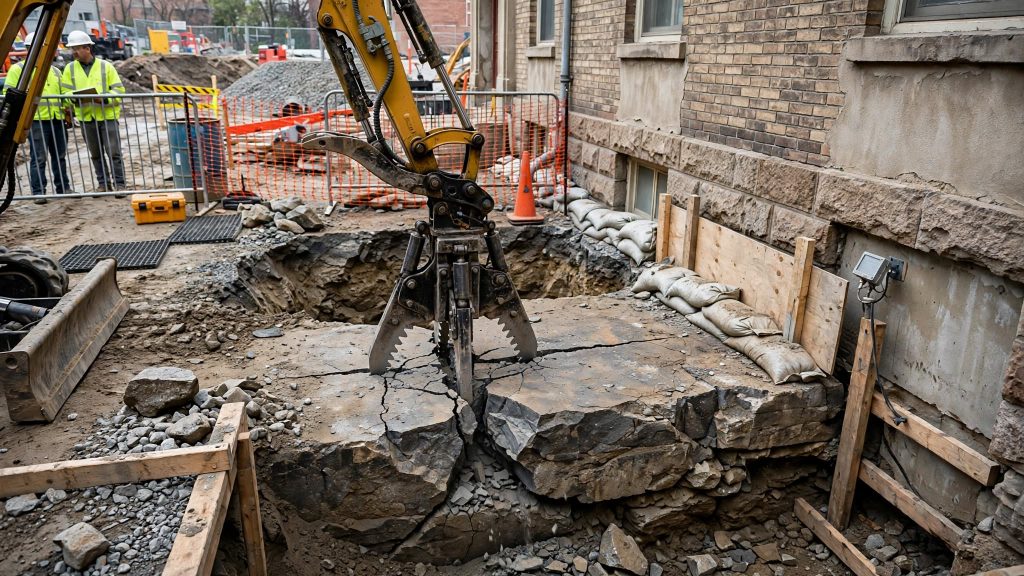
Excavating rock near buildings, retaining walls, utilities, bridges, foundations, or other existing structures requires more control than ordinary rock removal. The challenge is not simply breaking hard material. Crews must remove it while limiting vibration, uncontrolled cracking, flying debris, and disturbance to nearby assets.
Controlled rock splitting offers a more precise approach. Instead of relying on high-impact methods to fracture a large rock mass at once, the process creates planned breaks along selected lines. This makes controlled rock splitting useful for excavation projects where surrounding structures, underground services, or restricted working conditions leave little room for unintended movement.
What Is Controlled Rock Splitting?
Controlled rock splitting is a rock excavation method designed to separate rock along predetermined locations. Holes are typically drilled according to a planned pattern, and splitting equipment or suitable expansive methods apply force within those holes. The rock then fractures along the intended path.
The exact technique depends on the geology, access, excavation depth, project requirements, and proximity of surrounding structures. The central idea, however, remains the same: apply force where it is needed rather than subjecting the entire area to unnecessary impact.
This controlled approach can be particularly valuable when excavation takes place close to foundations, concrete elements, buried utilities, or sensitive infrastructure.
Why Excavation Near Existing Structures Requires Extra Care
Rock excavation can transfer energy beyond the immediate work area. Heavy breakers, impact equipment, and some conventional rock removal methods may generate vibration or cause fractures to extend farther than intended.
Near an existing structure, those effects require careful consideration. A crack that travels beyond the excavation boundary could affect the remaining rock mass or create additional work around foundations and structural elements.
Site conditions may also restrict equipment movement. An excavation beside an occupied building, for example, may provide little space for large machinery. Underground pipes, electrical lines, drainage systems, and communication services can further limit where crews can drill or break rock.
Controlled rock splitting helps address these challenges by concentrating the breaking action within a defined section of rock.
How Controlled Rock Splitting Improves Excavation Control
Planned Fracture Lines
Before splitting begins, the excavation area can be evaluated and drilling points laid out according to the required cut. Hole spacing, depth, orientation, and the characteristics of the rock all influence how the fracture develops.
This allows crews to work toward a defined excavation boundary rather than simply breaking rock until enough material has been removed. Better fracture control can also reduce unnecessary disturbance to rock that is meant to remain in place.
Reduced Reliance on Repeated Impact
Mechanical breakers remove rock effectively in many situations, but repeated hammering can create vibration and noise. Where nearby structures are a concern, reducing unnecessary impact may be an important part of the excavation strategy.
Controlled splitting applies pressure directly within drilled holes. Once a section separates, machinery can remove the fractured material with less need for continuous heavy breaking.
More Manageable Rock Sections
Breaking rock into planned sections can make removal easier in confined areas. Instead of dealing with irregular pieces created by uncontrolled fracturing, crews can work progressively through smaller sections.
For example, consider a trench being excavated through rock beside an existing foundation. Rather than aggressively breaking the entire trench area, workers can drill and split sections in sequence. Each loosened section can then be removed while the condition of the excavation face and nearby foundation is observed.
Site Assessment Comes Before Rock Splitting
Controlled rock splitting still requires careful planning. Rock is not uniform, and existing joints, bedding planes, weathered areas, groundwater, and changes in rock strength can influence fracture behavior.
The condition of nearby structures should also be understood before excavation begins. Similar inspection principles apply in other difficult environments. Signs Your Marine Structure Needs an Underwater Inspection is an example of how identifying visible or developing conditions early can support better decisions before work proceeds around existing infrastructure.
For excavation projects, the assessment may include the location of foundations, underground services, retaining systems, adjacent structures, and known weaknesses in the rock mass. Engineers and contractors can then select a suitable excavation sequence and determine whether monitoring or additional protective measures are appropriate.
Practical Considerations During Controlled Rock Excavation
A successful splitting plan needs to reflect actual site conditions rather than relying on a standard drilling pattern for every project. Important considerations include:
- Rock type, natural joints, and existing fracture patterns
- Distance between the excavation and nearby structures
- Required excavation depth and final rock profile
- Location of underground utilities and foundation elements
- Space available for drilling and material removal
- Appropriate sequencing of splitting and excavation
- Site-specific requirements for vibration, noise, dust, and debris control
Drilling accuracy is especially important. A poorly positioned or incorrectly angled hole can change the direction of the intended fracture. Crews should also avoid removing too much material at once when working close to structural elements.
Where Controlled Rock Splitting Can Be Useful
The method can support several types of construction and civil work. It may be considered for foundation excavations beside existing buildings, utility trenches through bedrock, basement expansions, road or bridge work, retaining wall projects, and rock removal in restricted urban sites.
It can also be useful where the final excavation boundary matters. Creating a more deliberate rock face may reduce unwanted overbreak and leave surrounding rock less disturbed than methods based primarily on repeated impact.
However, controlled splitting is not automatically suitable for every site. Highly fractured rock, difficult drilling access, unstable excavation faces, or unusual geological conditions may require a different method or a combination of techniques.
Conclusion
Controlled rock splitting gives excavation teams a way to approach hard rock removal with greater attention to where and how fractures develop. By using planned drilling, localized splitting forces, and staged material removal, crews can limit unnecessary disturbance around nearby foundations, utilities, and other structures.
Its effectiveness depends on accurate site assessment, appropriate equipment, careful drilling, and an excavation sequence suited to the geology. When those factors are properly considered, controlled rock splitting can be a practical option for rock excavation where precision and protection of existing structures are important.